
‘Family Straight-Jacket’ begins with a family lunch and a photo album. Through a series of conversations, family members identified moments where their capacity for meaningful growth was suppressed — by expectation, by silence, by the structures families build around themselves.
The straight-jacket emerged from those conversations. Made as both object and archive, it holds the words spoken against the skin that couldn't speak freely. Making was the method: the physical construction of the artefact was itself an act of research, turning lived experience into transmissible knowledge.
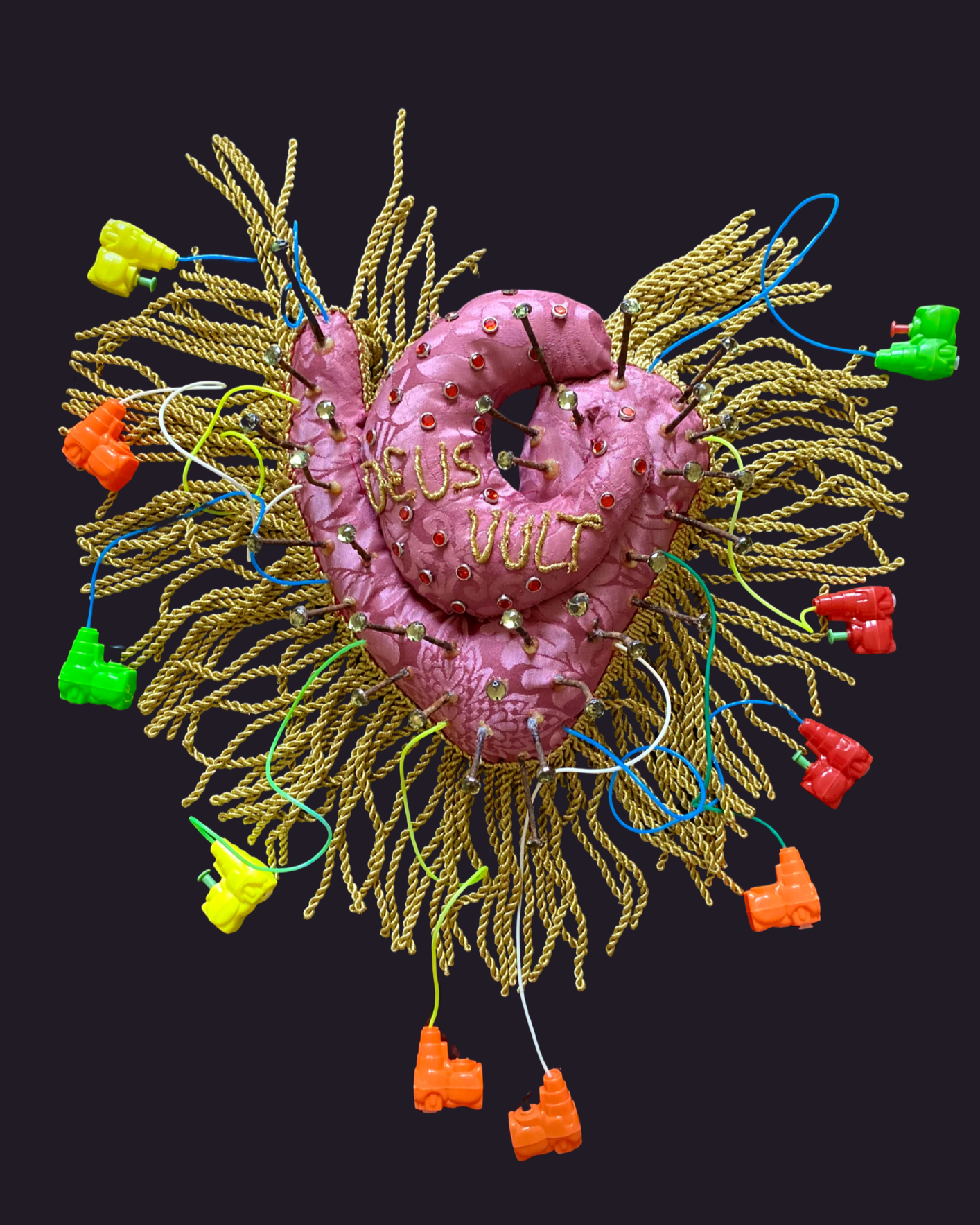
DEUS VULT
A heart-shaped form in floral damask brocade, pierced by rusted rhinestone-headed nails and surrounded by toy water guns. The words — God wills it — are embroidered directly onto the surface.
The sacred heart as weapon. Faith as justification. An object that sits within a broader practice examining how authoritarian regimes weaponise culture — the ornamental surface concealing, and eventually revealing, the violence beneath.
Nuno Reis is a Portuguese artist based in London whose practice moves between object-making, installation, and archival research. Working with materials that carry the residue of social existence — worn fabric, found objects, craft traditions — he examines how suppressed histories survive in the bodies and spaces that were never meant to speak.
His work takes the Estado Novo regime as a persistent point of return: not as historical subject but as a structure of feeling still active in the present.
He is drawn to the mechanisms by which power makes itself invisible — through ornament, spectacle, and the aestheticisation of everyday life — and to the traces left by those who moved through such structures while carrying something that could not be shown. Materials are chosen for their cultural specificity and their capacity to hold contradiction: the decorative and the violent, the normative and the suppressed, the exterior that performs and the interior that persists.
Nuno explores making as a form of knowing. Embodied practice, reaches places that other forms of knowing cannot access — allowing it to become a space of inquiry as much as production. His practice is also a pedagogic proposition, shaped by a belief that objects think, that making carries theory, and that the act of bringing together objects that operate at different historical and conceptual registers is itself a mode of research.

‘Body as Inventory’
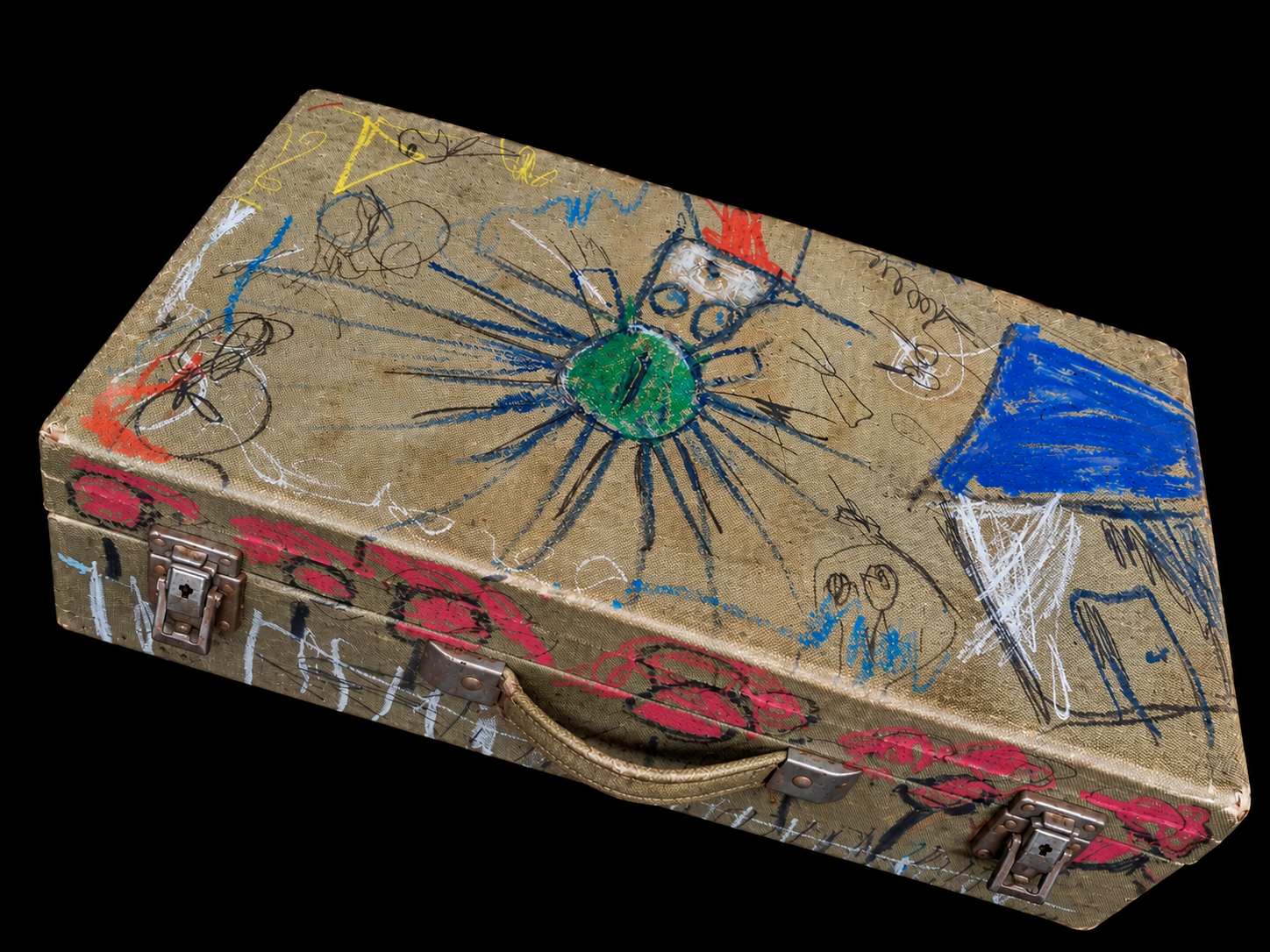
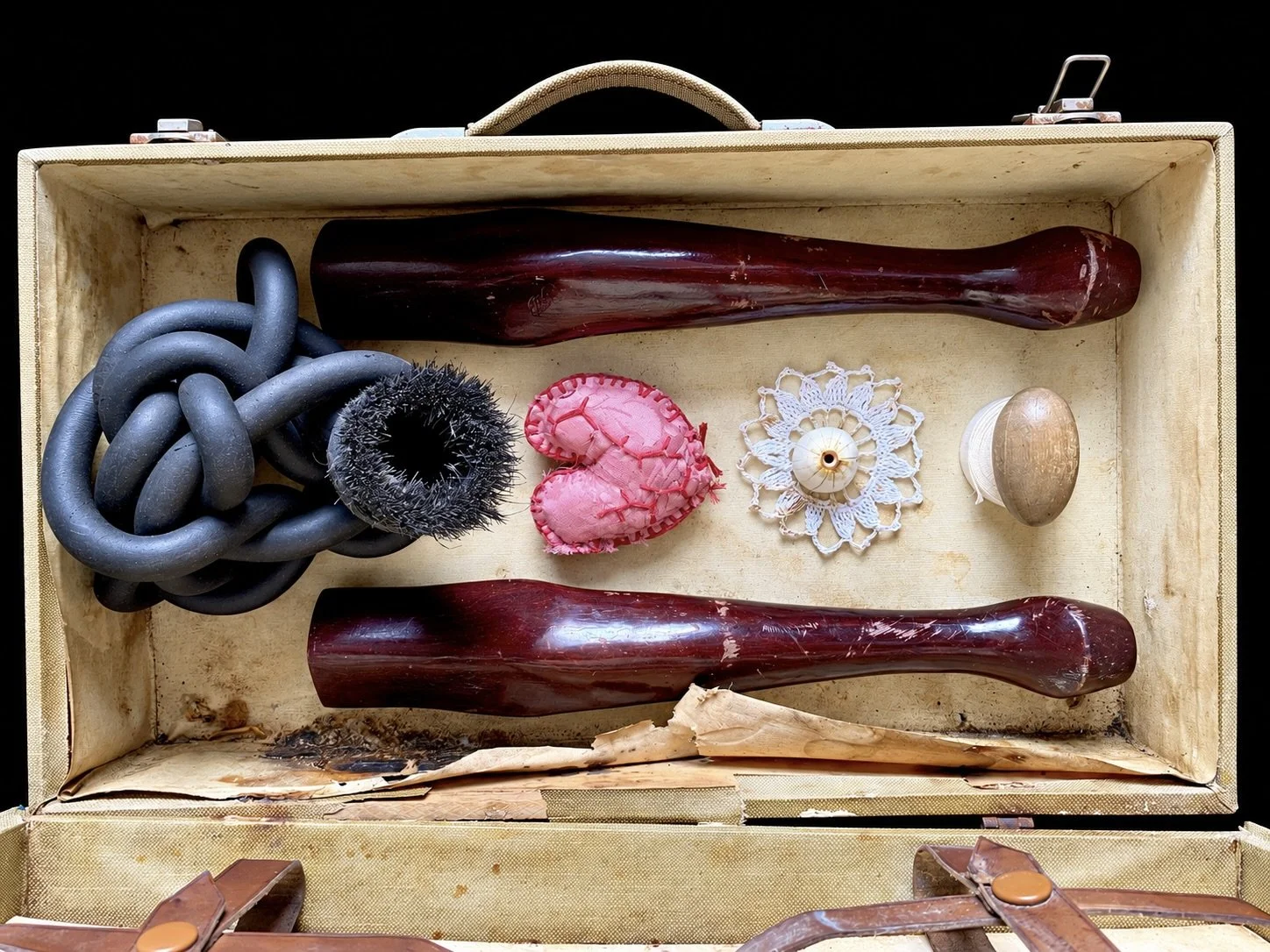
During Portugal's Estado Novo regime, women's bodies were expected to be productive, reproductive and domestic — valued through the roles they fulfilled rather than the lives they lived. In this work, the suitcase becomes an archive of those expectations. The objects do not represent a woman. They are the woman. A breast. A uterus. A pair of legs. Each reduced to its social function and carefully arranged within a system of order, classification and control. The body is dismantled and reassembled as inventory. Contained beneath straps, the objects are catalogued like possessions, stored like tools and carried like property. Even the chair legs cease to function as furniture. They become legs. The distinction between body and object begins to collapse. Both exist to serve a purpose. Both become components within a domestic and ideological infrastructure. The absence of the female figure is deliberate. She is no longer present as a person, only as the sum of the functions assigned to her.
The exterior of the suitcase tells a different story. Marked by the hand of a child, it reproduces a drawing I made of my pregnant mother and reveals a domestic reality often hidden beneath the regime's idealised image of family life. The scratched surface, fragmented markings and chaotic interventions speak of suppression, violence and dysfunction. If the interior presents the order imposed upon women, the exterior exposes the instability and damage required to sustain it. The suitcase becomes both archive and evidence, carrying not only the expectations placed upon women, but also traces of the realities those expectations helped produce. Its portability suggests how these roles and expectations are carried across generations, becoming part of what we inherit, preserve and sometimes struggle to leave behind.